
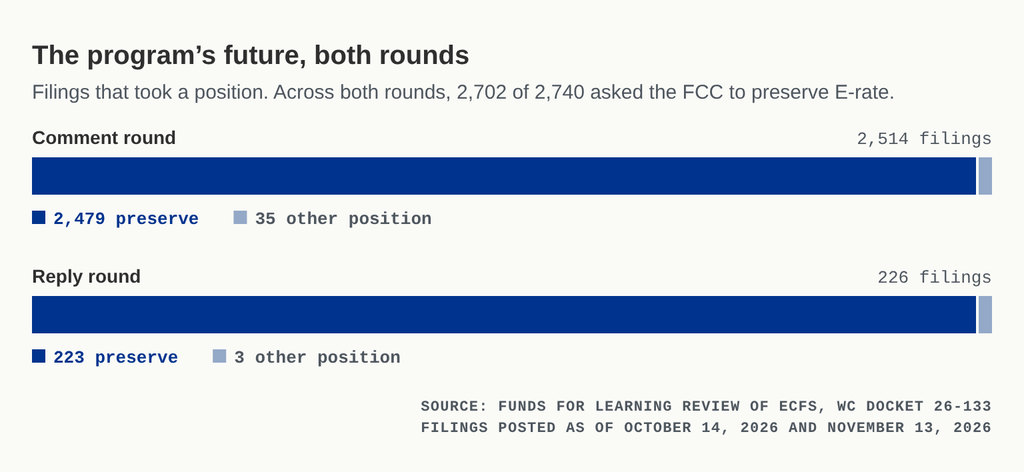
Reply comments, the second round in which filers respond to one another, were due November 12 in the FCC’s E-rate rulemaking, WC Docket 26-133. Funds For Learning went through the filings added to the docket since our last look on October 14. Nearly every new filing that took a position on the program’s future, 223 of 226, urged the Commission to preserve it. Across both rounds, that’s 2,702 of 2,740 filings, or 98.6 percent.
Filers still disagree about federal screen-time rules and the proposed consultant rules. The replies also include new requests on the discount matrix and cybersecurity eligibility. We filed reply comments of our own. They’re left out of the counts below, and FFL Asks the FCC to Streamline E-rate Instead of Narrowing It covers what we asked for.
Who filed
WC 26-133 held 4,359 filings on November 15, up from 3,276 on October 14. Of the 1,083 new filings, 816 came from two advocates who submitted research on radiofrequency exposure. We sorted the other 267 by who filed and what they asked for, including 110 that arrived on November 12, the reply deadline.
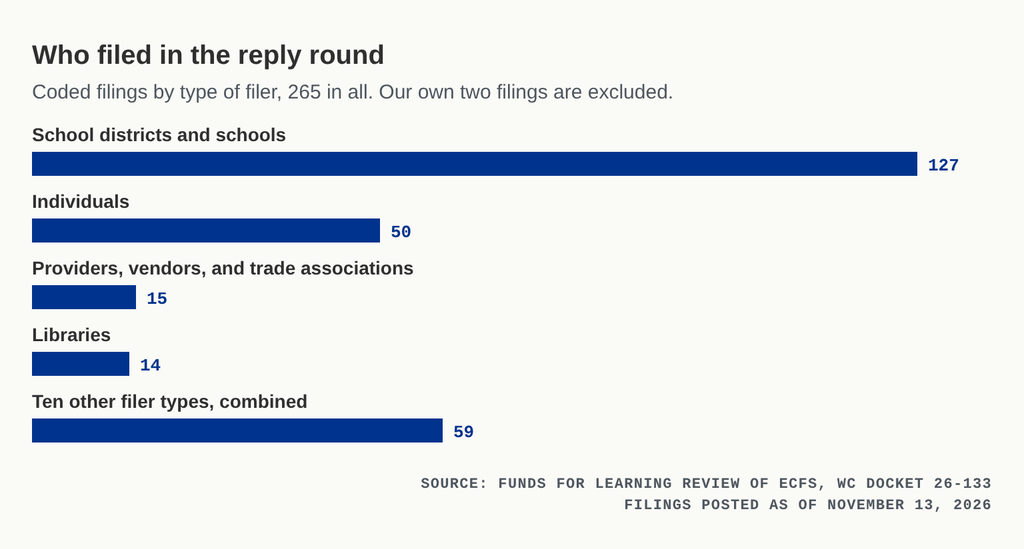
Leaving out our own two filings, school districts and schools filed 127 of the remaining 265, individuals filed 50, providers, vendors, and their trade associations filed 15, and libraries filed 14. Filers gave locations in 33 states, the District of Columbia, and the U.S. Virgin Islands. Mississippi (28), California (23), and Iowa (18) sent the most.
Ninety-five of them are form letters that follow one of nine templates. The most common, with 32 copies, offers “brief reply comments to support key points” made by national groups, which in 31 of the copies are AASA, CoSN, and SECA. Another 25 are copies of a district letter asking the FCC to “preserve and strengthen” E-rate.
The program’s future
The three filings that didn’t ask the FCC to preserve the program asked the FCC to narrow the program or took a mixed position. The Competitive Enterprise Institute (CEI) would lower discounts at the bottom of the discount matrix. On-Tech Consulting, which opposes a sunset, would cut the top discount rate from 90 percent to 80 percent. Children’s Health Defense would “reduce or reorient” funding for uses that it says increase dependence on screens.
None of the new filings in WC 26-133 asked the FCC to end the program. One filing in a companion docket, from Digital Liberty, asks for a phased sunset.
Only 18 of the 72 major filers we reviewed in October had filed a reply of their own by November 13. CEI was the only one of them that had argued for a smaller program in October, and it made the same case again. It wrote that the Commission may not “repeal that program’s mandatory core by rule,” and it said whether the discount obligation should continue “is Congress’s to address, not the Commission’s.”
New filers in the reply round
Several filers in this round weren’t among the major filers we reviewed in October. Rep. Frank Pallone, the ranking member of the House Energy and Commerce Committee, wrote that the FCC’s obligation to support schools and libraries “may not be reduced or abandoned without new direction from Congress.” The Governor of North Carolina and the state’s Superintendent of Public Instruction asked the FCC to preserve the program and reject proposals to sunset or substantially narrow it.
The Leadership Conference on Civil and Human Rights filed with seven co-signers. The National Action Network, the National Digital Inclusion Alliance, and The Utility Reform Network (TURN) filed replies of their own. New Mexico’s Office of Broadband Access and Expansion supplied ten years of state project data. Los Angeles Unified filed a reply, and 76 districts and schools joined three filings from Iowa area education agencies.
Screen time and CIPA
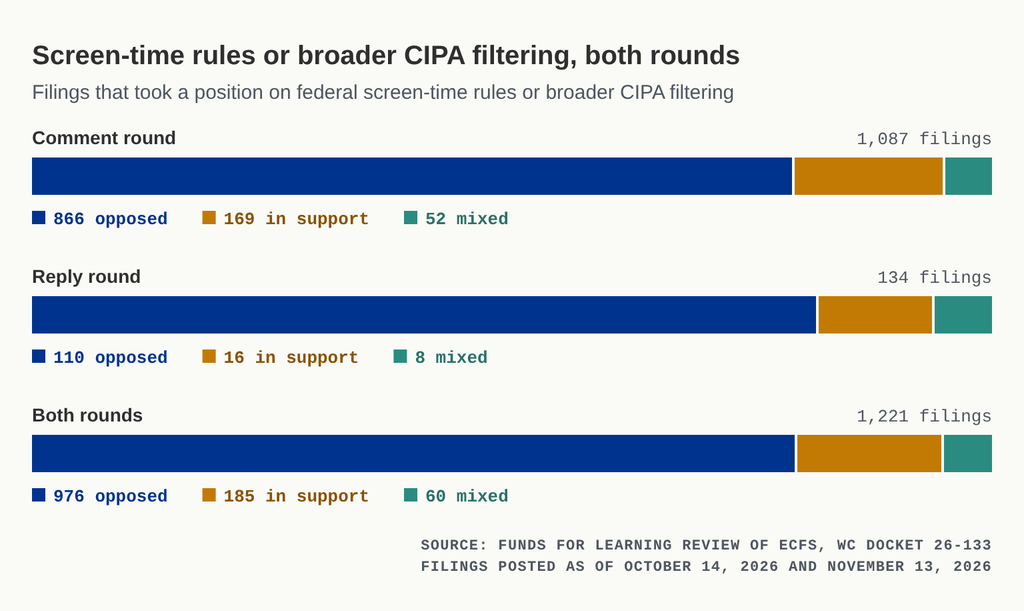
Federal screen-time rules still divide the record. In this round, 110 filings opposed them or broader CIPA filtering, 16 supported them, and 8 took a mixed position. Across both rounds, 976 opposed, 185 supported, and 60 were mixed.
Twelve of the 16 filings in support came from individuals, and seven of those follow one parent letter. The other four came from the Digital Progress Institute (DPI), Children’s Health Defense, Real Edu PAC, and the Institute for Families and Technology. DPI proposed that the FCC require every school that receives E-rate support to give parents notice and a simple way to choose a “reasonable alternative” to routine screen-based instruction. The school would decide what the alternative is. DPI also asked the FCC to collect and publish the internet safety policies that CIPA already requires. Part of its reply defends the legal basis for the program’s core discounts against the constitutional challenge from Consumers’ Research.
The Center for American Rights supports a parental opt-out and network-level filtering, but it wrote that “a federal screen-time mandate is the wrong answer, both legally and practically.” North Carolina’s Governor and Superintendent support the program and say the Commission “can adopt additional safeguards that support student safety and well-being.”
At least 31 filers said screen-time decisions belong to states and local school boards, or that the Commission lacks the authority to make them.
The Digital Childhood Council asked how the existing CIPA certification applies to generative AI features built into services that schools already allow, such as AI-generated answers in search results. It reported meetings in early November with Commissioner Trusty’s office, Chairman Carr’s office, and Wireline Competition Bureau staff, and it told Bureau staff it isn’t asking that funding be withheld.
Rural limits, the discount matrix, and special construction
At least 31 filers opposed limiting support to rural or single-provider areas, and we didn’t see a single reply arguing for a rural-only program. The Council of the Great City Schools noted that filers from rural states take the same position it does. Iowa’s Prairie Lakes Area Education Agency, joined by 41 districts and schools, said, “Although the districts in our region are predominantly rural, we do not support limiting E-Rate assistance to rural schools or schools served by a single provider.”
On the discount matrix, CEI asked for a further notice on lowering the minimum discount or compressing the lowest discount bands, and it said its requests “do not reach rural or urban status as an eligibility threshold.” On-Tech would lower the top band. SECA asked the FCC to issue a further notice before it makes any specific change. CENIC proposed a hardship exception above 90 percent, and E-Rate Central asked the FCC to raise the Category Two maximum discount from 85 percent to 90 percent.
At least 17 filers asked the FCC to keep special construction eligible. New Mexico’s broadband office reported that in Gallup-McKinley County, a $1.76 million project for three remote schools replaced 100 Mbps microwave service that cost about $672,000 a year with 1 Gbps fiber at about $97,000 a year.
Cybersecurity eligibility
CoSN asked the FCC to make appropriate cybersecurity products and services permanently eligible within defined funding limits. Zayo and INCOMPAS asked that security features bundled with eligible internet access qualify for Category One support. Benton, E-Rate Central, and Wayne RESA also asked for eligibility.
Form 479, MIBS, and Head Start
SHLB opposed the proposal to have each consortium member file Form 479 in EPC, and E-Rate Central asked for an offline option. Three Iowa area education agency filings asked the FCC to exempt consortia that seek support only for telecommunications.
At least 10 filers asked the FCC to keep managed internal broadband services (MIBS) eligible, among them Los Angeles Unified, ALA, SHLB, and the Texas State Library. At least 15 opposed changing Head Start and pre-kindergarten eligibility. West Virginia’s Department of Education said Kanawha County would lose $197,740.17 from its Category Two budget if those students were left out of enrollment counts.
Consultant rules
The FCC’s proposal would define, register, and certify E-rate consultants. Those proposals drew 16 filings in support, 3 opposed, and 15 with mixed positions. Across both rounds, 111 supported, 33 opposed, and 67 were mixed.
On the definition of consultant, SHLB asked the FCC to keep the existing one, which covers those who help with applications for a fee. ALA would exclude public employees such as state E-rate coordinators and state library staff. Six provider-side sales agents filed similar letters asking to stay outside the definition.
At least 10 filers, including Benton, the National Action Network, and three school districts, said new obligations and the consequences for missing them should fall on consultants and not on the applicants they serve.
Six filings took a side on the proposed ban on percentage-based fees. Four supported it and two opposed it. CEI supported the ban and asked the FCC to add public disclosure of consultant compensation. Five filings cited or discussed “The Cost of Connection,” the Senate Commerce Committee staff report on E-rate consultants that Senator Ted Cruz filed in the docket on October 13. As a firm that helps applicants with their filings, we have a stake in these rules. Our own filings, which aren’t in these counts, supported the proposed definition and opposed the ban on percentage-based fees. FFL Asks the FCC to Streamline E-rate Instead of Narrowing It explains why, and our comments and reply comments are in the docket.
What this means for applicants
The comment cycle in WC Docket 26-133 is closed, and no rules have changed. The FCC hasn’t said when it will act. Parties can still meet with Commission staff and file notices of those meetings in the docket. Applicants don’t need to take any action in this proceeding.
You can read all filings in the proceeding on the FCC’s website. If you have questions about what the proposals could mean for your applications, contact your E-rate Guide or reach out to us. For what we asked the FCC to do, read FFL Asks the FCC to Streamline E-rate Instead of Narrowing It. If you want more detail, the rest of this page has quotes from the filings, a short reading list, and a note on how we counted.
In their own words
On the program’s future
“[T]he FCC’s universal service obligation to support schools and libraries is not optional and may not be reduced or abandoned without new direction from Congress.”
Rep. Frank Pallone, ranking member, House Committee on Energy and Commerce
“Connectivity is not something a school district buys once and checks off a list.”
Davie County Schools, North Carolina
“The deeper question of whether the mandatory discount obligation itself should continue is Congress’s to address, not the Commission’s.”
Competitive Enterprise Institute
“The 90% discount is simply too close to free, and facilitates waste, fraud and abuse.”
On screen time
“The Commission would protect the choice; schools would decide what a reasonable alternative looks like; parents would decide whether to use it.”
“[A] federal screen-time mandate is the wrong answer, both legally and practically.”
“Schools receiving E-Rate subsidies should be required to provide reasonable, accessible alternatives for families who do not want their children to participate in routine digital instruction.”
“Screen time is an education pedagogy question, and it should not be conflated with basic connectivity.”
The Leadership Conference on Civil and Human Rights and seven co-signers
On special construction
“[W]here adequate infrastructure does not exist, prohibiting construction in the name of protecting competition can have the perverse effect of protecting the absence of competition.”
New Mexico Office of Broadband Access and Expansion
On cybersecurity
“Providing federal support for connectivity while excluding critical protections against threats to that connectivity is an increasingly difficult distinction to justify.”
“The Commission should recognize that cybersecurity is not merely an additional service unrelated to broadband connectivity.”
On consultants
“We ask the Commission to put most of the work on consultants, not schools, so that small and under-resourced districts don’t end up with a stack of new filings to keep the funding they already depend on.”
Lucia Mar Unified School District, California
“[A] paperwork failure by an outside consultant should not automatically deprive an otherwise eligible school or library of E-Rate funding without notice and an opportunity to correct nonfraudulent errors.”
Filings worth reading
Keep the program as it is
- EdLiNC (34 pages). A digest of supportive opening comments, organized by type of filer.
- SHLB Coalition (20 pages). Summarizes the record on affordability, the discount matrix, and special construction, and asks the FCC to keep the current consultant definition.
- SECA (19 pages). State E-rate coordinators ask for a further notice before any change to the discount matrix and offer new data on a five-year locked discount.
- American Library Association (19 pages). The library reply on authority, screen time, and CIPA, with a request to exclude public employees from the consultant definition.
- Council of the Great City Schools (17 pages). The urban case against a rural-only program, drawn from district and state filings in the opening round.
- New Mexico Office of Broadband Access and Expansion (26 pages). Ten years of state data on special construction, bidding, and prices.
- Rep. Frank Pallone (3 pages). The ranking member of the House Energy and Commerce Committee says the FCC’s obligation to support schools and libraries can’t be reduced or abandoned without new direction from Congress.
- Los Angeles Unified School District (6 pages). A large urban district on direct reimbursement, special construction, and MIBS.
Narrow it or rethink it
- Competitive Enterprise Institute (22 pages). Asks for a further notice on the lowest discount bands and says whether the discount obligation should continue is for Congress.
- On-Tech Consulting (7 pages). Opposes a sunset and proposes lowering the top discount rate from 90 percent to 80 percent.
- Digital Liberty (7 pages, filed in WC Docket 13-184). Asks the FCC to begin an orderly sunset of the program.
Screen time and CIPA
- Digital Progress Institute (22 pages). Proposes a parental “reasonable alternative” requirement and public posting of internet safety policies, and defends the program’s statutory core.
- Center for American Rights (9 pages). Supports a parental opt-out and network-level filtering and opposes federal screen-time limits.
- Digital Childhood Council (681 pages with exhibits). Asks how the CIPA certification applies to generative AI features inside services schools already use.
- Governor of North Carolina and State Superintendent of Public Instruction (2 pages). Supports the program and says the FCC can adopt added safeguards for student safety and well-being.
- The Leadership Conference on Civil and Human Rights and seven co-signers (5 pages). Argues that the FCC lacks authority to end or limit E-rate or to regulate screen time.
Cybersecurity
- CoSN (57 pages with appendices). Asks for permanent cybersecurity eligibility and attaches a 2026 report on K-12 cybersecurity.
- Zayo (5 pages) and INCOMPAS (6 pages). Ask that security features bundled with eligible internet access qualify for Category One support.
Consultant rules
- Lucia Mar Unified School District (8 pages). A California district supports the aim of the consultant proposals and asks that the work fall on consultants.
- National Action Network (5 pages). Supports consultant oversight and asks that a consultant’s paperwork failure not cost an applicant its funding.
- TechFreedom (36 pages with an attached paper). Opposes the proposed consultant rules and asks the FCC to reduce the program’s complexity instead.
How we counted
We pulled every filing in WC Docket 26-133 from ECFS on November 15, 2026, and set aside the filings that were in our October 14 snapshot. The latest filing in the pull was posted on November 13. Of the 1,083 new filings, 1,074 were received on or after October 14, and nine are paper filings that were received earlier and posted later. With AI-assisted review, we sorted 267 of the new filings by who filed and where each stands on the program’s future, federal screen-time rules, and the consultant proposals. For 160 of them, we worked from the first pages of text. We also read the main documents of 76 filings in full, 75 in WC 26-133 and Digital Liberty’s in WC Docket 13-184. Counts in this article that start with “at least” come from those 76 filings.
Each count is a filing in ECFS, not a separate filer. Some filers submitted more than once, and 95 of the 267 we sorted are form letters. We left our own two filings in this round, a notice of ex parte with our school internet price analysis and our reply, out of every count except the docket totals (4,359, 1,083, 1,074, 816, 267, and 110). Totals that span both rounds leave out all five of our own filings, three in the comment round and two in this one. We counted the 816 filings in which two advocates submitted research on radiofrequency exposure, but we didn’t sort or read them. In the “at least” counts, each filer counts once. Our 2026 E-rate Trends Report is its own entry in the docket, and we left it out of the October counts along with our comments and the reply comments we filed in August on the eligible services list.
A filer’s own reply counts only if ECFS had posted it by November 13. Six of the education groups without one are members of EdLiNC, which replied, and the ACLU co-signed the Leadership Conference’s reply. Filings made only in the companion dockets (WC 13-184, 21-93, and 21-455) aren’t in the counts, and we haven’t finished reviewing them.
Several replies cite the counts in our October 15 article. Those counts describe ECFS filings that took a position as of October 14. They aren’t counts of commenters, and the screen-time counts appear in the article and not in our comments.