
The FCC’s latest round of E-rate appeal decisions, released November 2 (DA 26-1156), is notable for how much of it turns on procedure rather than substance. Of 30 total decisions, 12 were dismissed, more than were granted or denied, and several of the denials rest on procedural grounds as well.
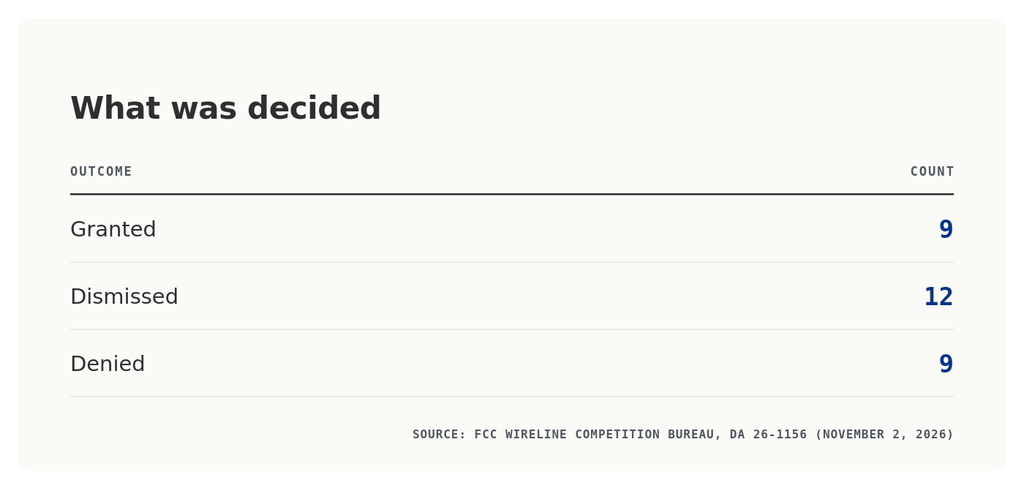
Granted decisions cover an inadvertent FRN cancellation, ministerial and clerical errors, funding increase waivers to assist service transitions, and special construction service delivery deadline waivers. The procedural story behind the dismissals and denials is covered below.
Procedure Is Not a Formality. It Is Part of the Case.
The pattern across this month’s order is consistent: if you don’t follow the correct process, at the right time, in the right order, with the right arguments, you won’t get relief, no matter how strong your underlying case is. That outcome is not unusual in E-rate appeals, but the volume of procedural failures in a single order this month makes the point worth examining in some detail.
Two applicants were dismissed because they filed their appeals directly with the Commission before first filing at USAC. Commission rules require you to file your appeal at USAC first if you’re seeking review of a USAC decision. Both were given 60 days to refile at USAC, but the delay and the additional filing step were entirely avoidable.
Six petitions for reconsideration were dismissed, several because the applicants raised arguments on reconsideration that had not been included in their original filings. The rule is clear: a request for reconsideration will only be considered if it relies on facts or arguments that were unknown or unavailable at the time of your original filing. If the argument was available but you simply didn’t make it the first time, you can’t introduce it later. One school district filed its original waiver request with no justification at all, then raised two substantive arguments for the first time on reconsideration. Both were dismissed on that procedural ground alone. But even setting the procedural problem aside, the Bureau reviewed those arguments directly and found they wouldn’t have succeeded anyway.
The Bureau addressed two arguments you might be tempted to raise, but that the program doesn’t recognize as special circumstances: confusion among staff about the rules, and the financial impact a denial would have on your district or its students. The Bureau stated plainly: staff unfamiliarity with E-rate requirements doesn’t rise to the level of special circumstances, and a denial’s impact on students doesn’t distinguish your situation from any other applicant facing the same outcome. Neither is grounds for a waiver.
One applicant argued that USAC’s out-of-window notification, sent when a Form 471 is filed after the filing window deadline, was not an adverse decision that triggered the 60-day deadline to file a waiver. The Bureau rejected this. The 60-day clock runs from the date of that notification, full stop. Here, the applicant waited 82 days before filing, and the request was dismissed and denied on that basis.
The Practical Takeaway
Know the correct sequence before you file anything. Include every relevant argument and supporting fact in your original filing. Treat every adverse communication from USAC as starting a clock. And understand that financial hardship and staff error, while genuinely difficult, aren’t the basis on which E-rate waivers get granted.
About the Author: Verlyne Jolley is a Director at Funds For Learning with more than 20 years of experience helping schools and libraries navigate the E-rate program. Her work focuses on regulatory compliance, program administration, and helping applicants understand and adapt to evolving FCC and USAC requirements.