
The FCC is weighing big changes to how E-rate and the rest of the Universal Service Fund are run, including who administers the program, how audits work, and what happens when the FCC decides money was paid out in error. Whether you are a one-person technology office at a rural school, a coordinator at a large district, or a library director, these questions can change how your applications are reviewed, audited, and paid.
On October 29, Funds For Learning filed reply comments on those proposals (WC Docket No. 26-173). Those filings are written for regulators and lawyers, so this article translates them. Each section opens with a plain-terms summary of what it means for you. If that is enough, move on; if you want the fine print, the details follow. One finding stands out across the record: none of the initial comments supported making applicants repay disputed funds before their appeals are decided.
Funds For Learning says the fix for USAC’s legal problem is authorization from Congress, not a new administrator.
In plain terms: You may have seen headlines about a court ruling against USAC, the organization that processes your E-rate applications. That ruling is about whether USAC was set up with the right legal authority, not about whether it does its job well. FFL says Congress should supply that authority rather than tear apart the organization your applications and appeals already run through, especially since independent reviewers have found that it manages the program well.
The details: USAC, the Universal Service Administrative Company, is the nonprofit that runs E-rate day to day. On October 15, the Fifth Circuit, a federal appeals court, ruled that the FCC lacked the statutory authority to establish USAC. FFL urged the FCC to work with Congress to authorize it, and noted that nothing in the ruling finds USAC administered the Fund poorly. The only commenter urging that USAC’s role end outright was Consumers’ Research, the group that brought the case.
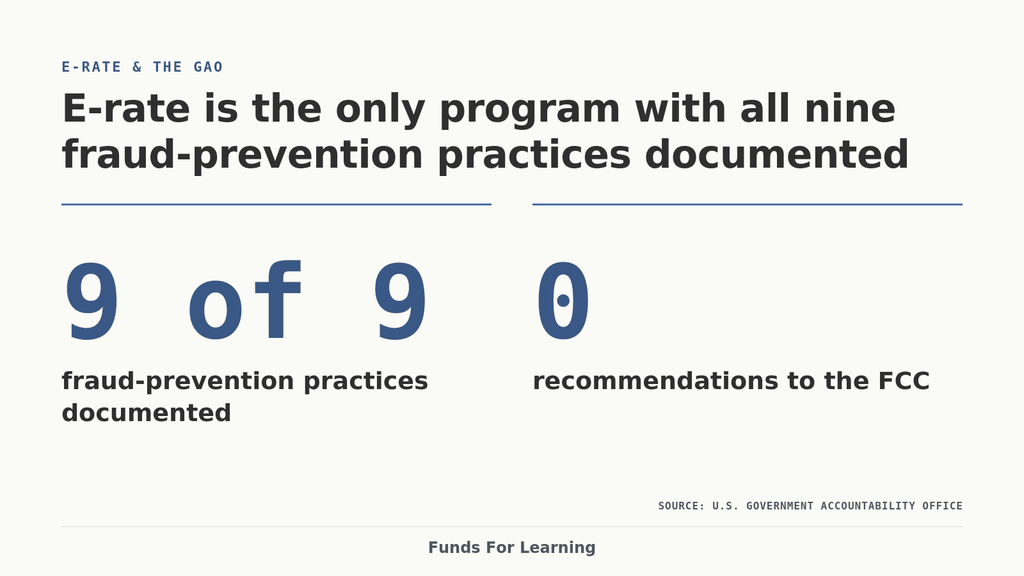
The performance record is where FFL leans in. In December 2025, the Government Accountability Office (GAO), the independent watchdog agency that reviews federal programs for Congress, compared five major federal programs against nine practices for preventing fraud, waste, and abuse. E-rate was the only one with all nine documented. GAO made twelve recommendations to the other agencies it reviewed and none to the FCC. The E-rate improper payment rate, the share of funds paid out in error, also fell to 1.27 percent for FY2024, below the statutory threshold.
FFL calls this year’s slow FY2026 funding decisions a transition cost, since USAC changed application review contractors and faces several open rulemakings. That argues for the speed measures discussed below, not for replacing the administrator in the middle of a contractor change.
FFL says you shouldn’t repay disputed money before your appeal, and audits shouldn’t rely on guesswork.
In plain terms: Imagine USAC tells your school or library to return funding, and you believe the decision is wrong. Under a proposal called pay-and-dispute, you would hand the money back first and argue about it afterward. FFL says that is backwards for public institutions on fixed budgets, because a refund two years later does not restore a school year. FFL also objects to extrapolation, where auditors check a small sample of your records and project the errors they find onto everything else you bought.
The details: Under pay-and-dispute, a participant would repay disputed funds while its appeal is still pending. The record is unusually one-sided: no commenter supported it, and CTIA, which represents the carriers whose procedure the FCC would borrow, opposed extending it. Rural health care commenters reported appeals pending five years or more and concluded that the real problem is how long appeals take to decide. The FCC’s Wireline Competition Bureau has reversed its own decisions more than fifty times in five years, according to the SHLB Coalition and ALA, so collecting first would punish applicants who turn out to be right. If the FCC proceeds anyway, FFL asks that applicants that are not carriers be exempt, that payment never be required before a Commission-level decision, and that reversed recoveries be refunded promptly with interest.
Extrapolation means projecting a sample’s results onto a larger group. FFL says that does not work across E-rate purchases, because each funding request has its own Form 470, bid evaluation, and contract. Sampling should stay within a single funding request, with the method disclosed and open to challenge before findings are final, and auditees should be able to choose a full review instead. Carriers agreed. Cincinnati Bell described USAC projecting six sample failures into a 10.53 percent failure rate without applying any margin of error, and another commenter showed that uniform rules force a 500-record district to produce 43.5 percent of its records while a 100,000-record district samples 0.38 percent.
FFL says USAC shouldn’t audit you and then judge its own audit.
In plain terms: Today, one organization handles nearly every step of an audit. USAC conducts it, decides what it found, calculates what you owe, and hears your first appeal of its own decision. FFL wants a different office to take that first look. FFL also wants USAC to report how many dollars have been decided, not just how many applications, and to publish its review standards before you file, so you are not denied over a rule you could not have known about.
The details: Commenters from every part of the Fund agreed that this is a problem. The Lifeline providers’ group NaLA says USAC “almost never disagrees with itself,” and NTCA documented what it calls “audit roulette,” different outcomes on identical issues depending on which auditor drew the file. WTA described a member that spent $150,000 responding to an audit of $350,000 in support. FFL proposes that first-level review of audit findings be handled outside USAC, by the Bureau, an independent review office, or an administrative law judge process for large recoveries, with audit methods open to challenge before findings are final.
On speed, 46 percent of requested FY2026 dollars, $1.67 billion, were still pending on September 2, because the requests that remain are the large ones. A count-based target can be met while nearly half of the dollars remain undecided, so Funds For Learning says turnaround metrics should track dollars and be published while the funding year is in progress. FFL also wants standards published before the filing window opens, changes applied prospectively, and anything USAC tells one participant shared with all. Missed deadlines should carry consequences for the process, never a finding against the applicant, and applicants whose filings are held for review outside USAC should be told and given regular status updates.
FFL backs four fixes: fewer audits, a five-year clawback limit, simpler bidding, and signed decisions.
In plain terms: FFL supports four changes that would lighten the load, especially for small applicants. Requests of $10,000 or less would be exempt from random audits, so a small request is not audited at a cost greater than what is at stake. USAC could recover funding only from the past five years, instead of potentially reaching back to your first funding year. Small-dollar purchases could skip the full competitive bidding process. And a named USAC official would sign every funding decision, so you always know who decided and who to appeal to.
The details: First, FFL recommends exempting funding requests of $10,000 or less from random audits. That is the most modest threshold in the record, and FFL says the FCC could adopt higher ones, up to the $250,000 some commenters proposed, because risk-based audits and investigations would still apply to everyone. Commenters cited a $21,000 reimbursement that cost more than $29,000 to audit, and ALA noted that 69.6 percent of libraries sought less than $10,000 in support for FY2023.
Second, FFL supports a five-year limit on recovery lookbacks. Applicants must keep records for ten years, yet no rule limits how far back a recovery can begin. A missing document in year nine can lead to recovery of support committed in year one. By comparison, the Department of Education generally cannot recover federal education funds spent more than five years earlier, and the IRS must generally assess a tax within three years of filing. A district can be asked to repay support from a decade ago, long after the staff who made the purchase, and sometimes the vendor, are gone.
Third, FFL seconds a proposal from the SHLB Coalition and ALA to exempt small-dollar requests from competitive bidding. A Form 470 cycle takes much the same effort for $5,000 as for $5 million, and for the smallest requests that cost falls on the applicants least equipped to carry it.
Fourth, FFL wants every funding determination signed by an identified, accountable USAC official, whatever tools USAC uses, including AI-assisted review. USAC has no authority to make policy or interpret unclear rules, and a signature costs little while identifying the decision maker if you appeal.
FFL says USAC’s Board needs people who actually file applications, held to the same conflict rules as everyone.
In plain terms: USAC’s Board guides how USAC operates, so who sits on it matters to every applicant. FFL wants the Board to include people who have filed a Form 471, answered a Program Integrity Assurance (PIA) inquiry, or been audited, alongside financial and audit experts. Some want to bar consultants from the Board. FFL says that would shut out many of the people best placed to serve, and it proposes one set of conflict rules for every member. FFL also wants the Schools and Libraries Committee kept.
The details: FFL wants directors with financial management, audit, and program administration expertise alongside practitioners who know the program firsthand. Program knowledge should be a stated qualification for every nominee, and new members should receive structured onboarding. The South Dakota Department of Education supports keeping school and library seats for the same reason.
In FFL’s 2026 survey, 56.4 percent of applicants use a consultant, and 79.2 percent of those say they cannot keep up with all the regulations. A Senate Commerce Committee staff report and the Center for American Rights urged barring people with a direct financial stake in USF programs from the Board. FFL says the Senate version would reach nearly every seat, since every school official, library director, and provider representative serves an employer with a stake in the Fund, and excluding consultants would shrink a pool of unpaid, informed nominees.
FFL’s answer is a single conflict standard applied evenly to every member. Each would declare their roles, disclose financial interests annually and publicly, recuse from matters of direct interest, and owe a duty of loyalty to the Fund. FFL also opposes eliminating the Schools and Libraries Committee, where stakeholder expertise reaches USAC management on a schedule and with a record.
Where This Leaves You
The initial comments came from applicants, carriers, state agencies, and coalitions that share little else, yet they reached similar conclusions: keep the administrator, do not collect before appeals are decided, limit extrapolation, separate auditing from deciding, publish the standards, and scale oversight to the dollars at stake.
Questions about how this affects your applications? Reach out to your Funds For Learning contact, or read the full comments and Funds For Learning’s 2026 E-rate Trends Report.
About the Author: Dirk Schroeder has been part of the Funds For Learning team for 16 years and calls Edmond, OK, home. Outside of work, he likes to hit the golf course as long as it’s not 100 degrees out.