
Funds For Learning filed comments today in WC Docket No. 26-173, the FCC’s review of how the Universal Service Administrative Company (USAC) runs the Universal Service Fund. Our message was that USAC is doing good work for schools and libraries and that the FCC should build on it. Most of our recommendations deal with how fast USAC makes decisions and how it treats schools and libraries when it seeks to recover funds.
The comments draw on our 2026 E-rate Trends Report survey and on funding request data from E-rate Manager.
Applicants give USAC high marks
In our 2026 survey, 82.8 percent of applicants said they’re satisfied with USAC, and 90.8 percent said they can depend on E-rate funding every year. That second figure is the highest we’ve recorded in the eleven years we’ve asked the question. Applicants are less satisfied with the process itself. Only 60.5 percent agree that E-rate processes are fast, simple, and efficient, although that is up from 34.7 percent ten years ago.
We asked the FCC to keep USAC as administrator and to avoid staffing cuts that would hurt service to applicants. Stakeholders should also have a standing channel to raise concerns about USAC’s processes.
Turnaround reporting should count dollars
The FCC proposed that USAC publish its turnaround times, and it asked about shot clocks, which are deadlines for USAC to act. We’re in favor of both. An expired clock should never count against the applicant, and the reports should track dollars as well as request counts.
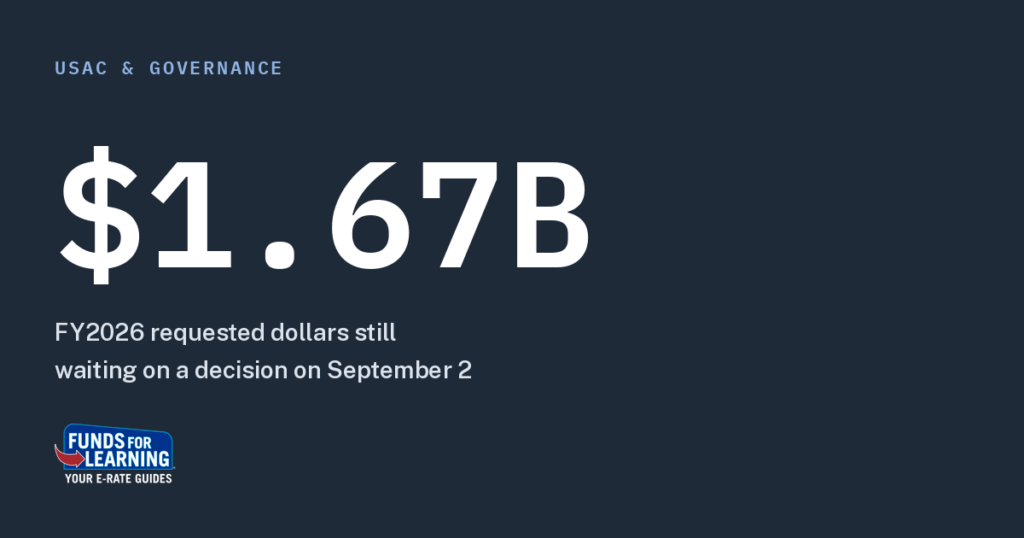
On September 2, 2026, $1.67 billion, 46 percent of all dollars requested for FY2026, was still waiting on a decision. About one in four applicants, 5,634 in all, were waiting on at least one request. In FY2021 through FY2024, the share of dollars pending on September 1 stayed between 20 and 25 percent. Because the requests still waiting are about twice the size of those already decided, a count of requests alone would understate the problem.
To be fair to USAC, it changed application review contractors this year and still committed $1.81 billion within two months of the funding year’s start. Back in 2014, the FCC directed USAC to decide all workable funding requests by September 1 and to report monthly on its progress in dollars. We’d like to see those reports made public. Our September 3 analysis of FY2026 funding status has the year-by-year figures.
When a filing goes silent
In our experience, the most damaging problem is a filing that goes quiet for months, sometimes years. Often the delay isn’t USAC’s doing. An office outside USAC, such as the FCC or its Office of Inspector General, is holding the matter for review, and nobody tells the applicant. A school or library can’t budget or plan around that. Whenever a filing, invoice, appeal, or audit leaves ordinary processing, we asked the FCC to require USAC to do the following:
- Tell the applicant that the matter is under review outside USAC’s normal process.
- Name the reviewing office or agency where the law allows.
- Send a status update on a fixed schedule, such as every 90 days.
USAC should also publish how long Form 471 reviews, appeals, SPIN changes, service substitutions, and invoices are taking, and to let each applicant see where its own filing stands.
Schools and libraries shouldn’t have to pay before an appeal is decided
The FCC asked about a pay-and-dispute model. A school or library would have to repay a recovery once the Bureau or the Commission has ruled, even with its appeal still pending. We urged the FCC not to apply that model to schools and libraries.
Districts and libraries work from fixed annual budgets. Money paid back mid-year comes out of that year’s classroom and library services, and a refund two years later doesn’t give the school year back. If appeals are taking too long, the fix is a deadline for deciding them. If the FCC goes ahead anyway, we asked that schools and libraries be exempt, that no payment be due while a timely appeal is pending, and that any reversed recovery be refunded promptly with interest.
USAC shouldn’t decide appeals of its own audits
Right now USAC conducts the audit, makes the finding, calculates the recovery, and then decides the first appeal of that finding. Government auditing standards and federal internal control standards both call for keeping those roles separate.
First-level review of audit findings should move outside USAC. The Wireline Competition Bureau or an independent review office at the FCC could handle it, with an administrative law judge for large recoveries. Another option is a separate audit division inside USAC, with appeals decided by staff who had no part in the finding. Sampling methods should be disclosed and open to challenge, and auditors should apply the rules and guidance in effect when the applicant filed.
Extrapolation across procurements
The FCC proposed letting USAC calculate recoveries by extrapolation, which means estimating a total from a sample, and asked whether that could reach across separate E-rate procurements. We don’t think it should. Every funding request comes from its own Form 470, bid evaluation, and contract, and a problem with one procurement tells you nothing statistically about another. If sampling is used at all, it should stay within a single funding request or contract.
A stronger and more open USAC Board
The FCC proposed several changes to the USAC Board of Directors. We asked it to do the following:
- Add directors with financial, audit, and administrative expertise, and keep the school, library, and service provider seats.
- Codify conflict of interest rules, and make annual financial disclosures public.
- Limit directors to two consecutive three-year terms, followed by at least one year off the Board.
- Require program knowledge for every seat, structured onboarding, and periodic Board self-assessment.
- Keep the Schools and Libraries Committee, and keep Board meetings open to the public.
On shrinking the Board from 20 members to 13, we didn’t take a strong position.
The FCC also asked whether program consultants and similar groups should be barred from serving on the Board. As a firm that helps applicants with their filings, we have a stake in that question. We opposed a ban by occupation and proposed one disclosure and recusal standard for every member.
Some USAC sessions are open only to an organization’s members or a conference’s registrants. We asked that anything USAC tells an outside group about program administration be available to everyone in the program. The comments also encourage regular open question-and-answer sessions before the new competitive bidding portal handles its first procurement in FY2028. In our 2026 survey, 57.5 percent of applicants agreed that the portal requirement will add to their administrative burden.
What comes next
Reply comments in WC Docket No. 26-173 are due October 30. If your district or library has waited on a funding decision, dealt with a recovery, or had a filing go quiet, the FCC should hear about it from you. You can file a reply comment through ECFS.
You can also read our full comments, including the data and citations. If you have questions about how these proposals could affect your organization, contact us.